
Start Here: Place, Activism and Solidarity
Our Justice Lead, Emma Temple, shares a reflection on how much where we are matters….
Where are you? You might be reading this on your sofa with your morning coffee. On the bus on your way into work. At your desk while you’re avoiding your to-do list…
I’m sitting at my desk. Fresh cup of tea warming my hands as the autumn chill starts to bite. Office chatter drifting in and out of my focus.
I’ve realised recently how much where we are matters. And it has everything to do with justice, activism, and solidarity.
In a world where ‘clicktivism’ and shouting into the echo chamber of online discourse is leaving so many of us overwhelmed, perhaps rediscovering physical place in our activism can help reignite our hope.
Not sure what I mean? Let me tell you a few stories…
Story One…
This month Claude Hendrickson joined us at Leeds Craftivists. He works on widening participation in climate activism. He asked us what countries around the world we had links to – a cousin in Canada, a sister in Norway, a recent railway adventure in Hungary. We realised Leeds is by no means an island – we’re part of a global community.
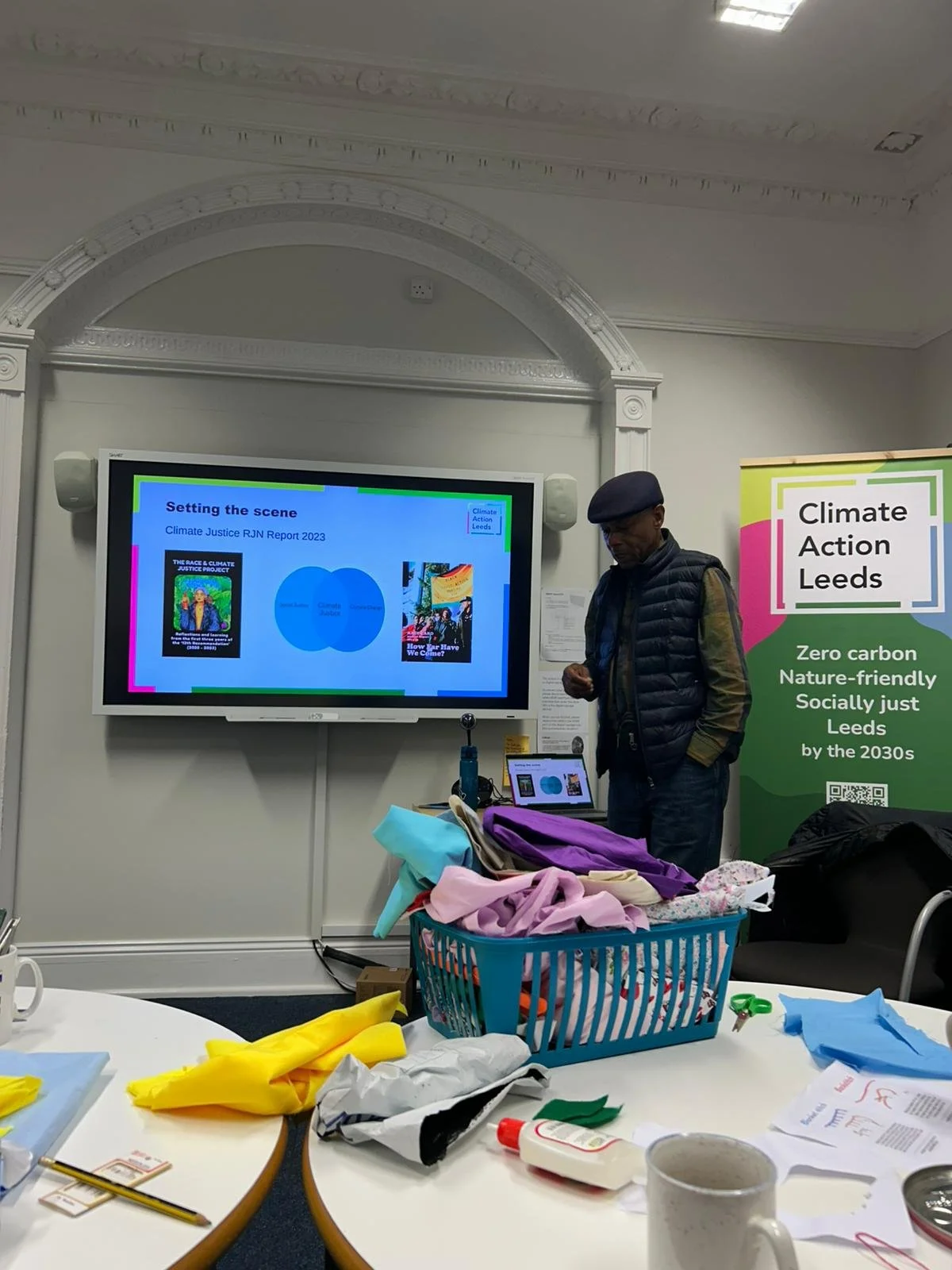
As we unpack the deep links between climate justice and racial justice, we’re learning how close to home this hits. People of colour in the UK are over 50% more likely to be in fuel poverty than their white neighbours, while companies established through the colonial period like BP and Shell announce eye-watering profits*. Given stats like these, it simply can’t just be white activists at the table discussing climate breakdown.
We asked what we could do to invite diverse communities into our (mostly white) craftivism group. But Claude said we’d got it all wrong – we need to get out of our comfort zones and go to them. His invitation to us was to go and meet in places where diverse communities feel at home. It was a wake-up call. At our next session, we’re looking for new local community centres to meet in. A tiny first step to show we’re serious about solidarity.
Story Two…
A couple of weeks ago, on a windy, rainy Friday evening, I pulled up at Tesco Seacroft car park. Various crowds were gathering – some carrying ‘Stand Up to Racism’ banners, some flying Union flags. They all made their way through dark underpasses to opposite sides of the busy main road. Then the shouting started.
At first I stood on the ‘anti-protest’ side. I’d been to protests before, I knew the drill – hold a banner, join in a chant, walk on the spot a bit to keep warm, then pack up and head home. But this protest was different.
After chatting with a few people – hearing stories of locals who were concerned about racist rhetoric, and seasoned campaigners who wanted to see a better future – me and a few friends crossed the road.
We were surprised to have some very similar conversations. We heard stories of lives made unbearable by a system that has forgotten this community. Of fears for the future from parents of disabled children, and anger towards elites that for too long have gotten away with driving an agenda of inequality.
In moving myself to the ‘other’ side, I was able to go beyond shouting about my perspective – I gained an understanding of a movement I thought I had nothing in common with. We started a dialogue. Perhaps even the beginnings of community.
Story Three…
At our latest Social Justice Lunch (spaces for seasoned and aspiring activists to share ideas over a sandwich – check them out if you haven’t already!) we asked: is Leeds an accessible city? You may be unsurprised to hear – the answer was a big no.
Disability rights campaigner Mo shared experiences she’s had of the everyday inconveniences of life in the UK as a disabled person. Her retelling of the battery on her wheelchair dying thanks to steep Yorkshire hills was at once hilarious and heartbreaking. So much extra planning and work is required for her just to be able to leave the house.
The point that stayed with me was this – if we don’t make cities accessible, people simply won’t come in. They can’t! For all the complaining that town planners do about city centres becoming deserted, they often don’t add the obvious ramps, curb drops, or accessible transport that people need to get there.
People with disabilities are literally blocked out from our public shared spaces – and that’s a huge injustice. In order to join in city life, they need to be able to be in the city. I vowed to take note of the places I visit, to think about how accessible they are, and try to take away a few of those extra inconveniences.
Story Four (last one!)…
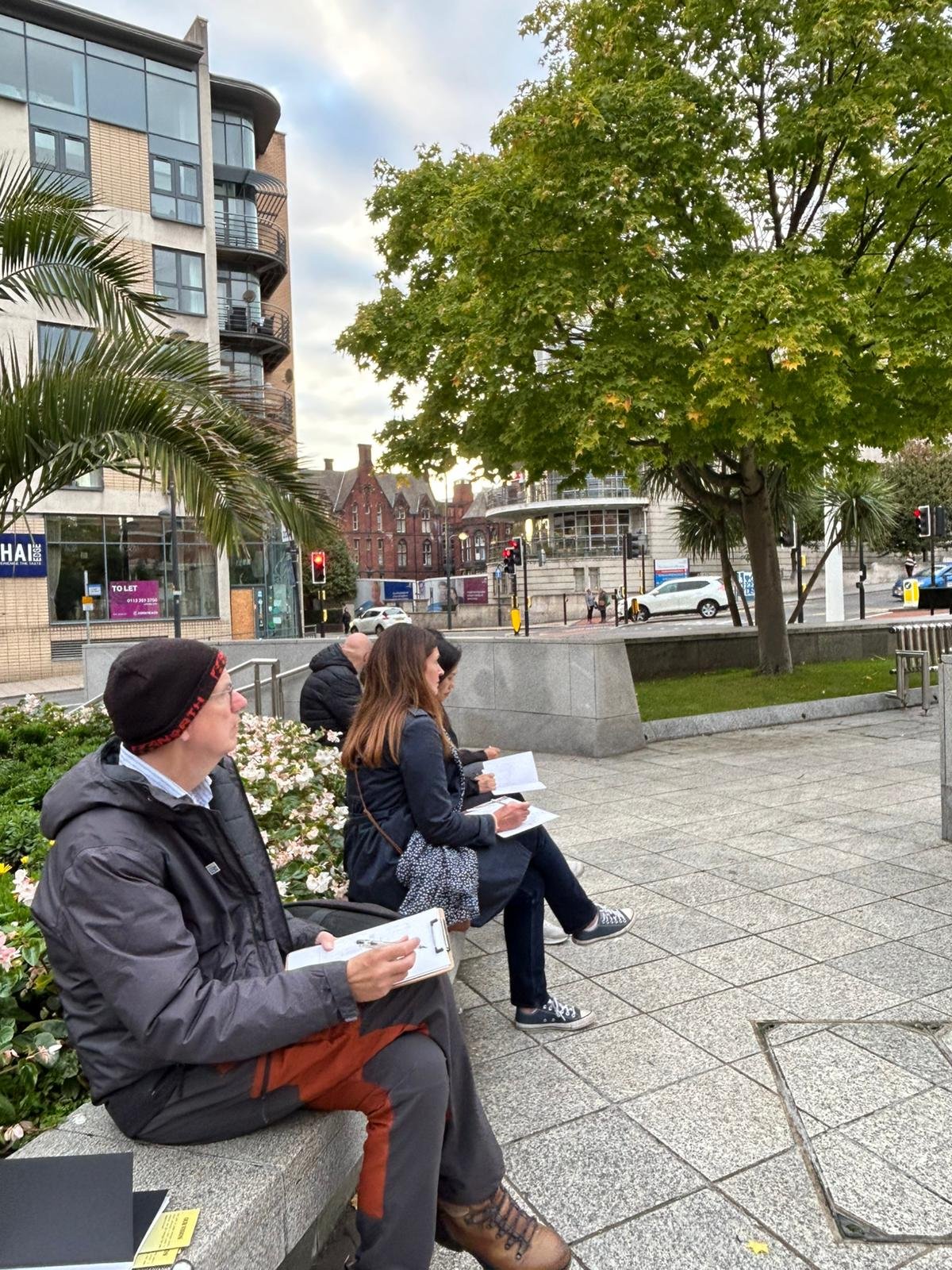
If you’d been walking down The Headrow a few Tuesdays ago, you may have spotted seven people peering down at a small bit of wall outside Leeds Art Gallery.
Historian and artist Clifford Stead was leading us on a Sketch Walk, learning about the history of war and peace-making in Leeds.
I was shocked to learn that this little section of wall bore scars I’d never noticed before – from bombs dropped during World War Two.
Standing in that spot, touching the deep craters in the Yorkshire stone, learning new things about the city I’ve called home for thirteen years – I felt more connected to my local community than ever.
The streets we walk down every day are steeped in history, and taking time to notice and sketch the place we live was transformative. It made the conflicts going on around the world today suddenly feel a lot closer to home, and inspired me more than ever to take action for peace.
So there we are – four stories about “where we are”. How physically moving and standing in a new place has helped me make tiny changes to the world around me. By thinking about, and perhaps even changing where we stand, we can move out beyond our normal communities, build dialogue with people we disagree with, open up places so everyone can access them, or get inspired to follow in the footsteps of change-makers from the past.
I’m back at my question: Where are you? Where could you be instead? Could standing in a new place offer you a new perspective – or spark a tiny change towards the world you want to live in?